
Practical explainer
What is a bone-marrow chip, and what can it prove?
A laboratory model helps researchers ask focused questions about immune cells.
NIH research announcement: September 11, 2026
In this article
What researchers built
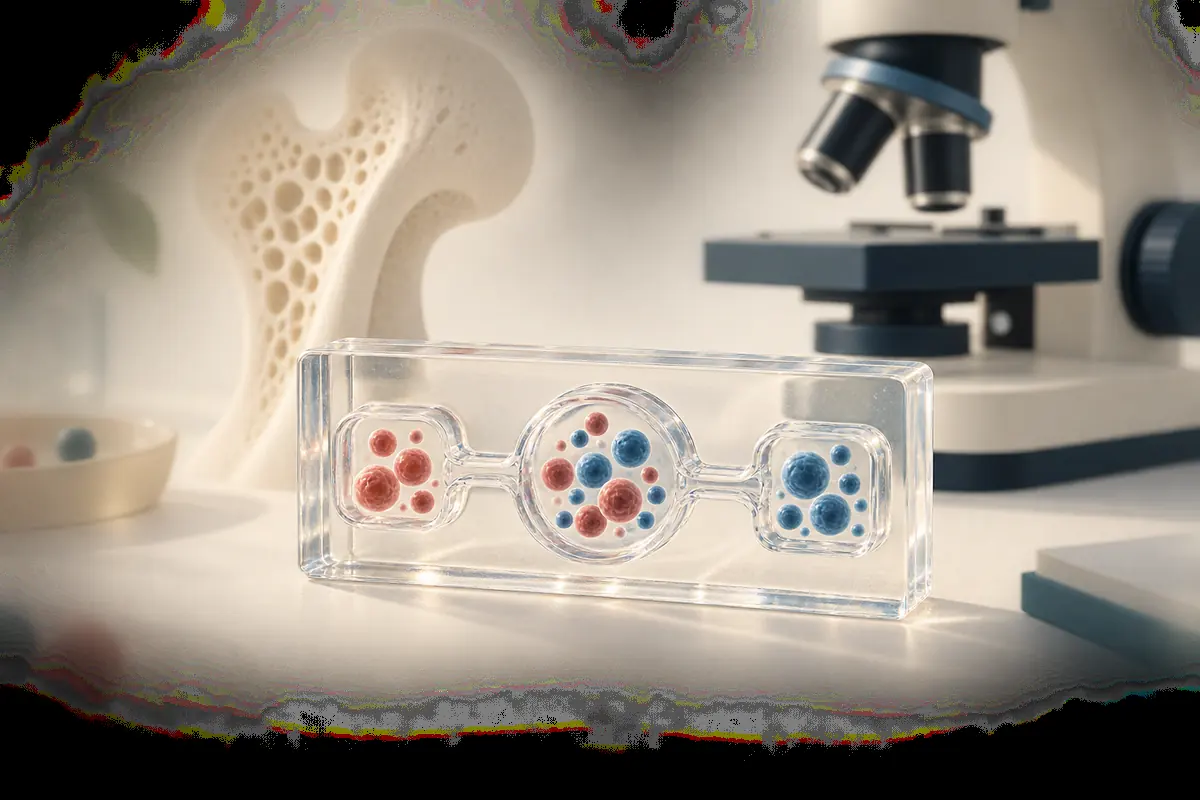
An NIH-funded team developed a system that links a model of lymphoid tissue with a chip that mimics bone marrow. It lets researchers study how plasma cells move, mature and survive. NIH announced the work on September 11. Read the original source.
Why these cells matter
Plasma cells make antibodies. Some remain in bone marrow and support long-term immune protection. Watching their behavior in living human bone marrow is difficult; the laboratory model gives researchers a simpler setting they can observe and change.
What it does not prove
The chip reproduces selected features of tissue, not the full human body. It is a research tool, rather than a new treatment ready for patients. The team hopes it can help investigate infection, allergy and autoimmune disease.
A model is useful because it simplifies a question
A laboratory model can let researchers observe a selected process under controlled conditions. Its usefulness does not depend on reproducing every feature of a whole person. The important question is which features are needed for the particular experiment, and whether the model represents those features well enough.
For a reader, that means replacing “Does this recreate the human body?” with narrower questions: what cells or tissue are included, what behavior was measured, and how was the result checked? The answers define the scope of the finding. They do not establish an all-purpose substitute for other research.
Keep the levels of evidence distinct
| Setting | A question it can address | A conclusion it cannot provide by itself |
|---|---|---|
| A laboratory model | How a selected process behaves under stated conditions | Whether a treatment is safe for a person |
| Research involving people | What happens in the studied participants and conditions | That every patient will have the same outcome |
| Wider clinical use | How an available intervention performs in practice | That uncertainty or monitoring is no longer relevant |
NIH describes laboratory work and clinical studies as different parts of the research process. Promising laboratory findings can lead to further investigation; they are not automatically clinical results. NIH research-process explanation.
Use a three-line note to read the next breakthrough headline
- Write the experiment: what exactly did the researchers build or measure?
- Write the boundary: which participants, cells, conditions or outcomes were included?
- Write the next unanswered question: what additional evidence would be needed for the headline’s broader implication?
For this kind of report, do not infer a product launch, approved therapy or personal treatment benefit from the existence of the model. If a secondary article makes that leap, return to the original research or announcement and look for the evidence supporting it. A careful explanation can recognize the model’s research value without promising a clinical outcome that has not been demonstrated.
Expanded with a practical explanation and checking framework. Original publication and source dates are retained.
Sources & dates
Sources checked September 16, 2026. Prepared with AI assistance. Read our editorial standards.


Comments
Loading comments…